In 1993, my 104 year old grandmother died. In her estate were a collection of letters my father had exchanged with his parents during his college years. It is not clear whether his parents had saved these, or if he had been storing them at his parents’ home, nor if he had stored them, how long ago. With cell phones, families no longer write letters. In my prep school European history class, we read Thomas Mann, Buddenbrooks written in 1901 which chronicles the decline of a wealthy North German merchant family over four generations (1835 to 1877). In 1967, I read André Malraux, Anti-Memoirs. Malraux had been at least a participant observer in many of the important civil wars during his adult lifetime. He focuses on the times these took place rather than on his family. The first president of the Progressive Education Association who became the president of Antioch College from 1921 to 1936, did not himself complete college. He recruited my Harvard educated grandfather to chair Antioch’s teacher education department in 1922. In 1929 at the start of the great depression. My grandfather was recruited to found a parent owned k-12 progressive coed day school with an essentially unlimited budget for grounds and buildings. By my father’s generation, patrons were not funding new private schools for their children, so my father wanted to do something else with his life rather than just step in and take over his father’s school when his father retired. I am not a Thomas Mann nor an André Malraux, but I have a lot of material that illustrates how different the opportunities and challenges were for different generations. I was able to locate and interview three college women my father had mentioned in his letters to his dad. One of them knew the story of my conception. When I was three, my parents bought their first new furniture, a matching pecan set of two twin bed and dressers. My mother was please about this but to me this transition to separate beds didn’t portend well. My father was the nurturing adult in my life. He would take me to visit another faculty couple at the Putney School. Fernando and Stepha Gerassi had been best friends of French feminist, Simone de Beauvoir and her common law partner, Jean-Paul Sartre. My father would be animated in conversation with them, which he was not around my mother. Fernando painted, so the smell of linseed oil and turpentine still puts me in a good mood and several of my later partners have been artists.
In 1949, my father had been hired by the Putney School. One of the demands of the teacher strike in 1948, was that the founding headmistress consult an advisory group. My father was elected to represent the rest of the faculty.
That Thanksgiving, English teacher, Abbey Brown celebrated with us and in 1950 wrote a children’s story for me which captures well what it was like as a 3 year old eating with faculty and students and visiting teachers with my father.
As French historian Philippe Ariès, described it, the concept of childhood as a distinct stage has been a quite modern development. In this page, I will describe my childhood as I experienced it, mention things I noticed and was puzzled by but which did not much distract me at the time. I will defer to another page how I came to understand these mysteries looking backwards after I had the information I needed to make sense of them. My childhood was definitely a safe and secure curated subset of the larger reality around me.
My parents did not own a home of their own until after I was an independent adult and my parents had divorced. During the academic year we either lived in a rental or in faculty housing provided by the schools my father taught at. As a private school teacher before teachers’ unions, my father’s income was very modest, but he was never unemployed during my childhood and he had the summers off with his annual salary divided into 12 equal payments. During the academic year we lived as a nuclear family. During the summer, however, we lived as an extended family that included my father’s parents, two married younger siblings and all my paternal cousins in a summer home that my grandparents had bought in 1926.
We are influenced by interacting with our relatives, but also by their furnishings. This picture hung on the wall in the dining room of my paternal grandparents summer home in Vermont. Family narratives are interesting for what they include, but also for what is excluded. This next photo is the opening bracket. As a child, I had no information on my grandfather’s career between his first employment in Colorado Springs, until his final employment as the founding headmaster of Metairie Park Country Day School (1929-1956) Each fall he left his summer home in Vermont to resume running his school in a suburb of New Orleans. I did not know why, he, a New Englander, would consent to teach in the segregated south. To the extent that I pondered this, it seemed opportunistic. He had wanted to found his own k-12 coed progressive school and the chance to do that hadn’t found him until 1929, while his wealthy classmate, Perry Dunlap Smith, had founded North Shore Country Day School already in 1919,
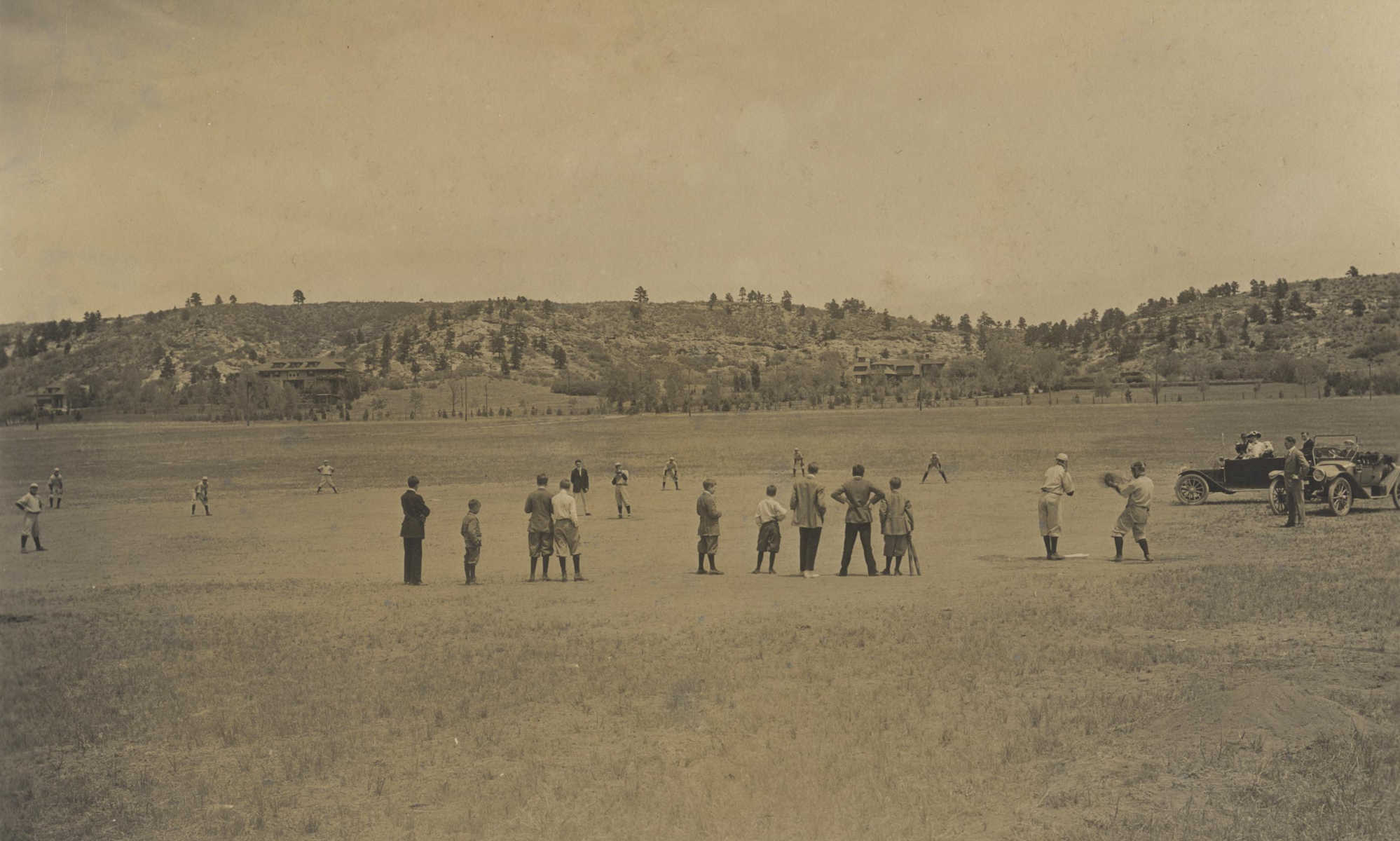
Ralph Edwin Boothby (1890-1964) had graduated from Harvard in 1912 and was immediately hired, first to teach (1912), and then to direct (1915-1922), by the outgoing director of the St. Stephens School, who was unsurprisingly an earlier graduate of Harvard. In my website header image, which I got from an heir of an elderly student of this school, you can barely see the next image in the upper left corner of the header image.

My father, Lawrence Warren Boothby (1918-1976) was conceived on his parents’ honeymoon which consisted of a horseback trip from Colorado Springs, CO where his father was headmaster of the St. Stephens School, to Santa, NM, and back. This was the second summer student horseback trip he had led. His wife was a year older and had had an earlier summer as a graduate student of John Dewey at Columbia Teachers College. Unmentioned during my childhood was that Ralph’s mother-in-law moved in to attend my father’s birth in 1918 and never returned to her husband. She did not die until 1938. In my grandparents’ summer home bedroom was a desk that only Ralph used. We were not allowed to visit him in this room. As a child, I assumed that my grandparents shared this bedroom, but I don’t actually know this. What I did observe is that any time the meal time conversation got “interesting” my grandmother would start circulating a platter of meat or a full bowl that no one had requested and which required full attention to avoid spilling. Ralph barely condescended to eat with the rest of us and retired directly to his study after the meal. I encountered this pattern later in the family of my middle partner. When first introduced to her parents, her mother announced that she expected her two daughters to never leave the family home. The younger didn’t. Maryann was 6’2 when not wearing heals. One of her family rules was that her husband should be taller. That restricted the potential candidates.
My father’s two younger siblings followed in quick succession, a brother, and then a sister. Once the mother-in-law moved in, she dominated the household and the three children had to go to their father’s school to see him. The mother-in-law moving in altered the generational boundaries reverting my grandmother from a wife of her husband back to the daughter of her mother. This created two hostile factions, Ralph and my father whom he hoped would take over direction of the school Ralph founded in 1929, and the mother-in-law with her daughter and my father’s two younger siblings. In 1938, they would veto my grandfather’s opportunity to take over direction of the Fieldston Ethical Culture School when its outgoing director, Herbert Smith, who was a Harvard classmate of Ralph’s recommended him.
Here is a posed picture of the three children when Ralph was president of Western Reserve Academy (1924-1929) in Hudson, Ohio.

In 1924 the president’s house above was under repairs so a wealthy patron of Western Reserve Academy, James Ellsworth, lent my grandparents temporary use of his Hudson, OH villa. I didn’t see this picture until I inherited a history of WRA in 1993 from which I have scanned this plate. James’ son was an early arctic and antarctic explorer. https://en.wikipedia.org/wiki/Lincoln_Ellsworth . My father made a list of books he read at Dartmouth which included Lincoln Ellworth, Beyond Horizons, 1938,which I have since read. Larry’s roommate’s parents ran a mission in Fort Yukon, Alaska. Larry decided to leave Dartmouth after his junior year to volunteer his services in Fort Yukon, write about his adventures and then head to Guatemala for more adventures to write about.

Hudson, OH was hot and humid in the summer. Mrs. Ralph E. Boothby had grown up in MIddlebury, Vermont. In 1926 my grandparents bought a 6 bedroom, 2 bath farmhouse with detached barns from the parents of Weston, VT architect Raymond Austin.


We did not own a new car until 1956. This car below had been my grandparents and the next was a Jeep station wagon with a cracked block from freezing without proper anti-freeze. that my father bought from his sister’s family. My dad had hoped it only needed a new head gasket, then that the head needed planing. By the time it was fully repaired it had cost as much as a new Jeep. In the picture below we are moving from either Milton Academy or the Putney School for our summer vacation.

Three pictures with my dad on the 100 acres he had bought on Moses Pond Road for a writers retreat after his brother repaid him for his loan to him for 93 acres for an artist colony.


I spent the first ten summers of my life with my grandparents, my cousins, and our respective parents. My father’s sister, Theodora, had married first, then my father’s brother, Norman, Finally my father, the eldest. Theodora had a daughter Linda, the eldest of my generation. I arrived next. During these years we had little information about our grandparents between the brackets of Saint Stephens School and Ralphs’s final position as the founding director in 1929 of Metairie Park Country Day School from which he retired in 1956. In this section I will limit myself to what I knew and experienced during these years. Much later in 1993 when my grandmother died at age 104, my father’s college letters to his own parents showed up in her estate. My father had predeceased his mother in 1976. I don’t know whether my grandparents had saved my father’s college letters to them, or whether my father had saved his letters and was storing them at his grandparents home after his second divorce when he no longer had his own home.
Families no longer write letters and most of their cell phone conversation with older generations of their family get lost. Democracy is impossible without an informed electorate. Each generation confronts very different opportunities and challenges. Without historical context, our current situation domestically and in forever wars produces anxiety because with the concentration of corporate media, the very wealthy are able to propagate false narratives that privilege them at the expense of the workers who do the actual work in the economy. The wealth of a few is the product of poverty of the many. Global free trade obscures the details of how this works. The US has reinvented itself in earlier dark periods so I have hopes that it will again. For young people without this historical context, the current case is anxiety producing.
The small slice of the real world, as I experienced it as a child was care free and well tailored to my developmental needs at that time. I believe that this was by intention of my father and grandfather and I acted on the same considerations as a step parent of a 2 year old later. Confidence is a learned response to success in navigating more and more interesting challenges. Failure can be traumatic, so what my young step daughter witnessed were an interesting curated progression of challenges she would always succeed at. We started her at HeadStart a year early. In her second year she assisted her teachers in teaching other students to read. By kindergarten she had already had the experience of being a peer leader. She maintained that leadership until my ex remarried and they placed her in a Catholic women’s prep school.
The 6 bedroom home became crowded as our generation arrived. First, my uncle Norman bought a 93 acre farm outside the same village with financial help from my father who had not married yet. When his wife received an inheritance, they repaid my father who then bought an adjoining 100 acres. Neither of these two properties had electricity. Instead of building on these 100 acres, my parents built a 12′ x 36′ initial start on a home on my grandparents’ land across the orchard from the main house. We did not have internal plumbing until I was ten. We continued to eat meals with my grandparents. You can see the foundation for the intended living room that was not built. Initially I was an only child. My parents had planned to sleep in a fold out bed in the living room. My little brother first slept in a crib in the bathroom where the future bathtub was planned. When he outgrew his crib, he slept on a couch in the dining room. Then he was off at a summer camp for a number of summers because he was too young to play with me or my cousins.


During my father’s generation, Weston had its own free community rope tow behind the Wilder Library. That slope had once had a ski jump. On weekends during the academic year we often drove to Weston to stay in my grandparents’ vacant summer home. Driving towards Weston, my father always pointed out the church in Manchester, VT where my parents had married. He never mentioned it when driving the other direction to our rental, or school provided housing. I now know that I was a 3 month old fetus when my parents married and that my father’s father did not attend their wedding. While my father was he nurturing adult during the academic year, he was remote during the summere. Fortunately my mother’s twin sister never married and spent her summers with us in Weston. I knew I was her favorite nephew. She took me and my cousins swimming daily and sometimes on camping trips.
First trip to White Rocks scenic outlook.


White Rocks is most interesting to climb up these gigantic boulders to meet the Long Trail at the top and then to follow the trail down the stream to the camp ground which affords multiple falls and pools to skinny dip as my father and I did this trip. My aunt was present, but did not join us skinny dipping.

One summer my father’s sister’s family, now 3 children, built a tent platform above our grandparents’ home.

The walk from this tent platform to the grandparents’ house has this view:

Then my grandfather had a chance to buy an adjoining 32 acres. This property had a brook. a main house, multiple small out buildings, and a large shop that had collapsed. Linda and Farren remodeled two outbuildings for themselves. Jessica built a small tent platform for herself. The property had electricity, but no water other than from the brook. Farren and I built a tree house with salvaged lumber from the collapsed shop building.
Here is the outbuilding Linda renovated. Its windows overlooked the brook and beaver dam. The original owner had his own sawmill and this building was his lumber drying building. There had once been a wood stove under the floor grid where the green lumber was stacked to dry above. Linda’s father had an interest in architecture. He trimmed a wedge off the bottom of the rafters and nailed it on the top giving the roof something of a Japanese look. Linda, Farren, and I applied the new asphalt 3 tab shingles and we learned that white reflected the sun light and would be cooler inside during the summer.

In my earlier summers, I spent more time with my father, his brother, Norman, and my cousin Deborah. From my father’s letters to his father, I now know that my father loaned his brother approximately half of the purchase price for a 93 acre farm and farm house on the other brook from the lake above my grandparents’ summer home. When Janette received an inheritance, they repaid my father and he bought the adjoining 100 acres. Initially Norman and my father kept these and the grand parents’ fields mowed with a horse drawn sicklebar mower pulled by “tricky tractor,” an automobile that Norman has cut the middle out of and welded the front and back sections back together.
At some point, perhaps when Norman moved to NYC without his family to become dean of Parsons School of Design, and he spent less of his summers in Weston, grandfather Ralph bought a walk behind Gravely like this stock picture.


That sickle bar could chew through 3/4″ saplings that sprouted below the maples along the stone walls defining the fields. Its wheelbase was quite narrow. It was very heavy. The fields were rugged with boulders to avoid. It did not have an electric starter. You wrapped a leather strap around the flywheel, braced one foot on top of a tire, and put all your weight into pulling the strap. If it backfired, it tore the strap handle out of you hand. The summer I could first start it by myself and was heavy enough to press down on the handle to raise the sickle bar over rocks, marked my transition into adulthood. This coincided with several summers in which my father was out of state in graduate school, first on sabbatical at MIT and then completing a master of education from Harvard.
In the summer of 1961, age 15, I moved out into a tent for privacy. I had electricity for reading at night and for a radio.
In 1962 I had a chance to salvage lumber from the fire of the summer playhouse detached dormitory building. I built my first cabin on a granite cliff on the upper end of my father’s 100 acres. Like my parents’ summer house, it had a view of the West River valley below and the mountains beyond. My initial goal was to have my own private bedroom. A kitchen with sink and propane cook stove/oven was added later under the rear eaves. My only refrigeration was the spring farther up the hill which flowed by gravity to the sink faucet. The propane tank also supplied one gas light.

Initially, access was up the cliff by ladder and through a trap door in the floor, but in this picture from 1964, I have changed access to a path around the cliff to a new orange sliding door. My mother’s twin sister loaned me her Blaupunkt FM/AM car radio which I powered from a car battery. Vermont educational FM stations had jazz programs and when the when the weather was right I could tune in to an AM jazz station in NYC and another in Baltimore.


The following Christmas, My oldest cousin, Linda Bratton, gave me a book on Le Corbusier with this sketch inside. His Notre-Dame du Haut ,Roman Catholic chapel in Ronchamp, France had a totally different program than my cabin and used materials that were not native to my site. In the summer of 1966, I requested Berkeley’s catalog for their Department of Environmental Design and having finally paid off my Reed College tuition loan, hitch-hiked out to San Francisco to establish California resident status so that when I had saved some money I could resume college more affordably. What appealed to me was the tension between their very diverse faculty. I was unable to get my draft board jurisdiction changed from Vermont to California., so returned from California the next February.

My grandfather retired in 1956. The k-12 private day school he had founded in 1929 granted him a retirement package to fund winterizing his summer home and building a glass room between the house and the detached barns. Ralph had had his leg arteries replaced. That surgery was successful, but he never walked again without a walker and he stopped driving. In the winter my grandparents rented in the village. This next picture is later from January 1960. In 1956, the contractors were instructed to prioritize answering every question I asked as I watched them replace sills, pour a concrete basement floor and walls where had been only stacked stone walls, pour a concrete water storage tank, and replumb the water supply pipes with new copper. They roughed in a new glass room between the main house and the detached barns. Later, when I was 15, I spackled the seams and nail holes of the sheetrock.

Taken much later in the summer of 1968, this picture show the glass room built to connect the detached barns to the main house. It had a view of the meadow across the road and the brook beyond.

Here is Tangela with her current husband David, of 31 years and his granddaughter from his first marriage. David is a Reed College alumnus with a PhD in sociology.. I have recently had a DVT and stroke and am in a nursing home pending surgery. They helped me print and mail my state and federal tax forms on time.

My grandparents’ summer home living room. It had a Franklin wood stove for heat.


(Insert picture of Linda and me playing in sandbox)
Amazing ski sweaters my mother’s twin sister knitted for me.

(insert pictures of White Rocks climb and Lowell Lake)
Stock picture of White Rocks.
The 1963 VW bus my partner, Tangela, and I bought used in Spanish Harlem In February 1967 for $950 to live in. This picture is from late summer 1969. My mother had won the land under my first cabin in her divorce in the summer of 1965. She had also won the exclusive right to use our summer house which my dad had not yet inherited from his parents. I had been promised some land under my cabin when I turned 18, then when my parents divorced, then when I turned 21, then when I married. Since we couldn’t live in my first cabin, Tangela and I took it down to salvage its lumber.

We built this second cabin from the salvage of my first cabin in the summer of 1968. Now the kitchen was indoors. It is the same 8′ x 16′. Windows, and views from them, defined the separate functions of bedroom with reading chair, dining table, and kitchen at the other end. For privacy, the path to the door had no windows facing it.


In the spring of 1969, I added a septic tank, drainage field, and an addition for the bathroom. In the fall of 1969, I had finished my two years of alternate service.

That winter I started studying architecture by interlibrary loans guided by a syllabus commissioned from architect, Graham Williams of Rensselaer Polytechnic Institute, which I had attended for my freshman year of college. The Weston Public Library had just started doing interlibrary loans, so I was able to borrow large format architecture books from Harvard and Yale.
My father planned to deed me 2.47 acres of the 20 that he would inherit in 1970. In part this was because he had borrowed $500 from me in the fall of 1964 and never made a payment on the $1,600 he had borrowed from two other sources for my Reed College tuition. I ended college after my sophomore year to repay these tuition loans. Before building a real house, I wanted to run an independent pipe to my grandparents’ spring. My aunt, Tibby, vowed to go to any legal expense to make sure I could not access water from her parents’ spring. Having witnessed my parents having built a summer house on my grandparents’ land that they never finished building because they didn’t own the land under it, Tangela and I decided to leave Weston for Portland, Oregon where we had met when I was a sophomore at Reed College.